- Home
- ather of the Bride Speech & Toast
Father of the Bride Speech & Toast
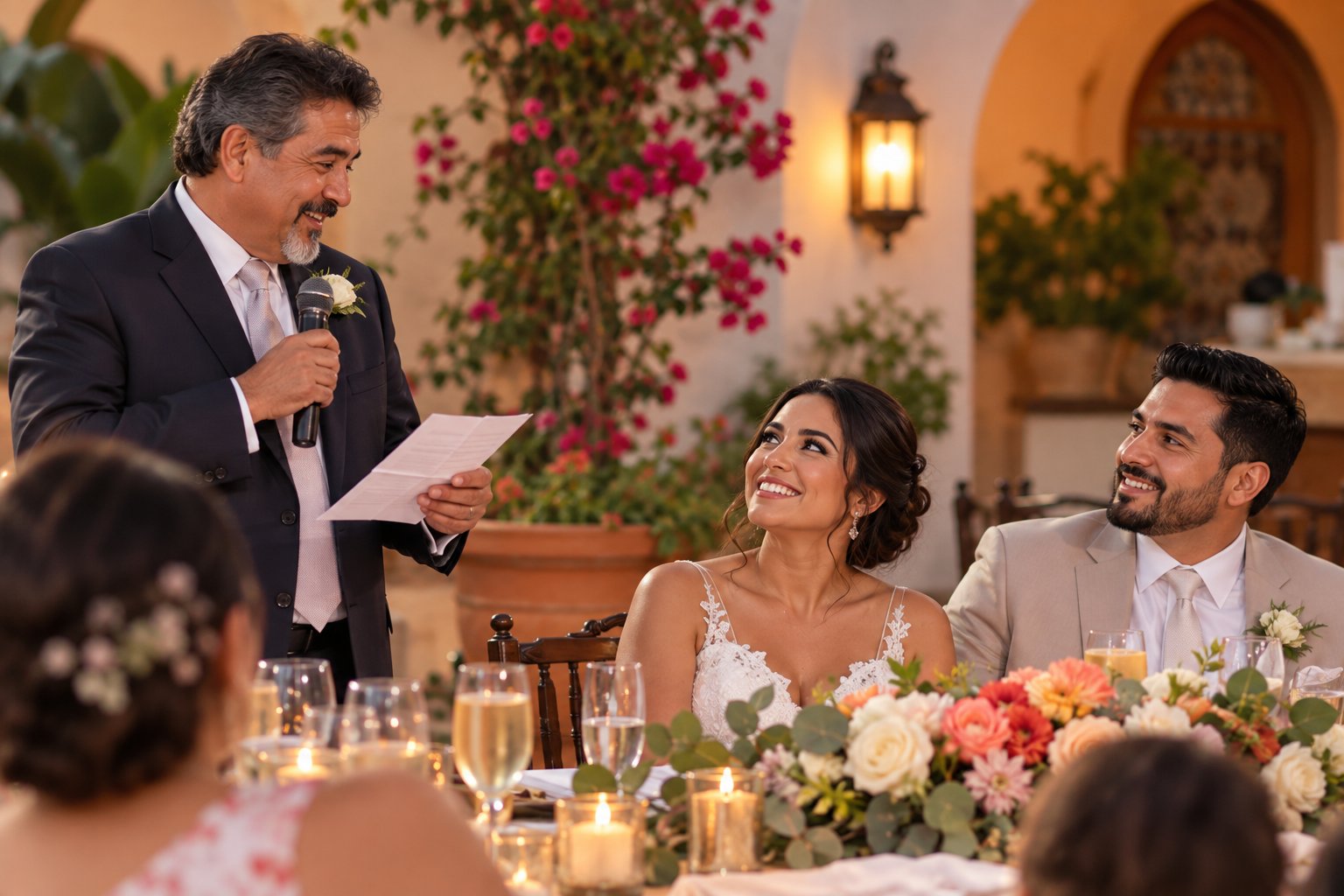
A father of the bride speech can be one of the most memorable moments of a wedding reception.
It can also be one of the most intimidating.
How do you put years of memories into a few minutes? How do you tell your daughter what she means to you without becoming so emotional that you cannot finish? How much should you say about her new spouse? Should you be funny? Should you give advice? And how do you end with an actual toast?
The good news is that you do not need to be a polished public speaker.
You don't need a collection of clever jokes, either.
You simply need something meaningful to say—and a comfortable way to say it.
The best father of the bride speeches usually sound less like a performance and more like a father talking about someone he loves.
What Is the Father of the Bride Speech?
Traditionally, the father of the bride was often considered the host of the wedding reception, particularly when the bride's parents hosted and paid for the wedding.
Weddings have changed.
Today, couples may pay for their own wedding. Both families may contribute. There may be stepparents, adoptive parents, two fathers, two mothers, grandparents or other important people who have helped shape the couple's lives.
So think of the father of the bride speech as a tradition rather than a rule.
If you are giving this speech, your most important role isn't to represent an old wedding custom.
Your role is to speak from your relationship with your daughter and to welcome and celebrate the person she has chosen to share her life with.
Speech or Toast — What's the Difference?
The speech is the larger message. It might include a welcome, a story about your daughter, some thoughts about the couple, and perhaps a few words about marriage. If you'd like to understand where this fits with the other speeches given at a reception, see our complete guide to wedding toasts.
The speech is the larger message. It might include a welcome, a story about your daughter, some thoughts about the couple, and perhaps a few words about marriage.
The toast is usually the conclusion.
That's the moment when you invite everyone to raise a glass and offer a wish for the couple's life together.
Your speech might last five minutes.
Your actual toast might last fifteen seconds.
Knowing the difference can make writing the whole thing much easier.
How to Write a Father of the Bride Speech
Don't begin by trying to write a speech.
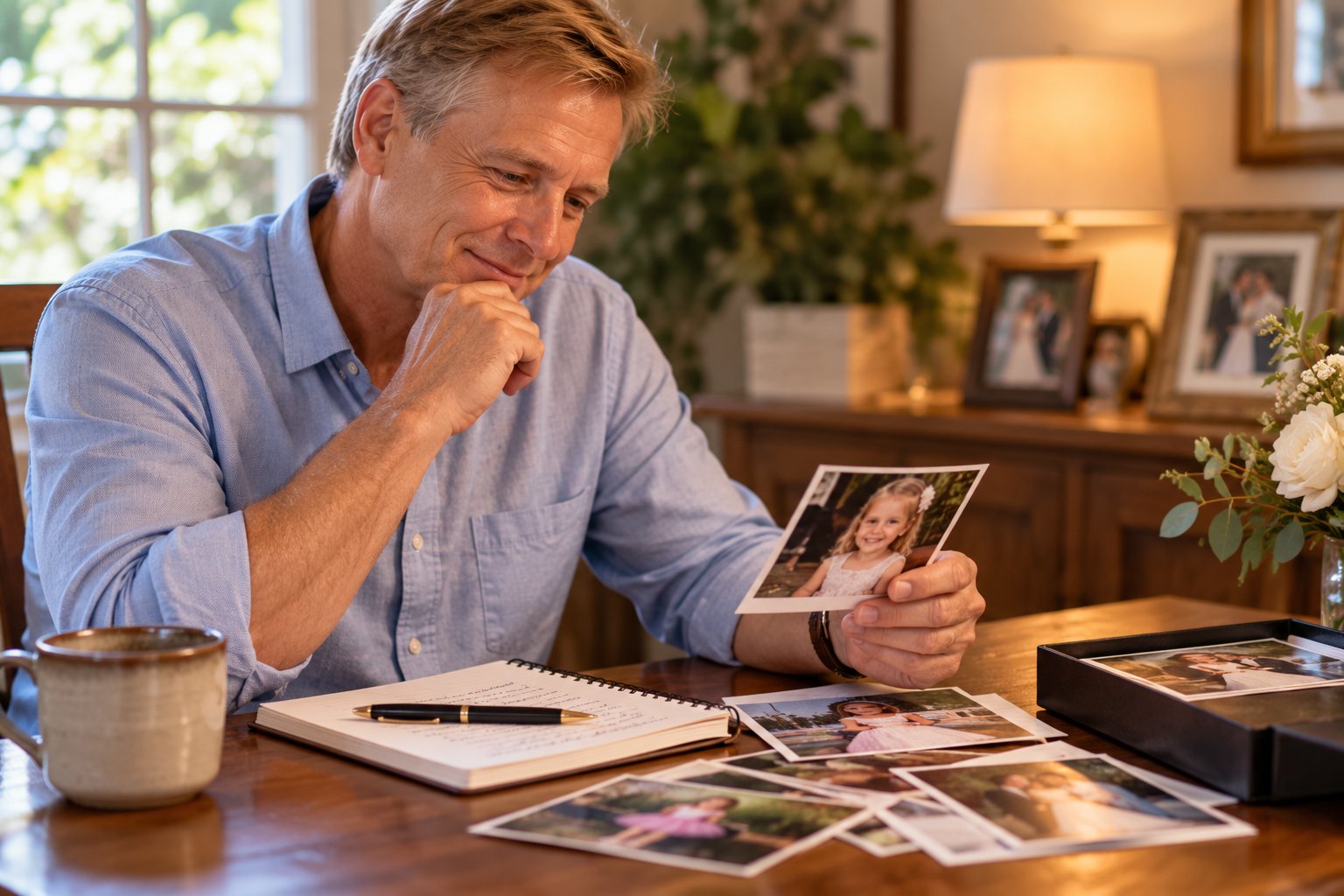
Begin by remembering your daughter.
Before you worry about opening lines, jokes or eloquent conclusions, jot down some memories.
What was she like as a little girl?
What qualities did you see developing as she grew?
What made you particularly proud?
What have you learned from her?
When did you first realize that her relationship with the person she is marrying was becoming something important?
What do you appreciate about the two of them together?
Somewhere in those answers is probably your speech.
If you'd like more help developing your ideas into a complete speech, our How to Write a Wedding Toast guide takes you through the process step by step.
A Simple Father of the Bride Speech Structure
If you're staring at a blank page, try this five-part structure:1. Welcome
Briefly welcome everyone and acknowledge the significance of the day.2. Your Daughter
Share something that tells people who she is—not merely what she has accomplished.3. A Story
Tell one short story that illustrates something about her character or your relationship.4. The Couple
Turn your attention from your daughter alone to the two people getting married.5. The Toast
Finish with a sincere wish for their marriage and invite everyone to raise a glass.
That's enough.
You don't have to tell her entire life story.
What Should a Father Say About His Daughter?
This may be the hardest part because there is so much you could say.
Resist the temptation to give everyone a chronological biography:
"She was born in 1996. She started kindergarten in 2001. Then she played soccer..."
Instead, ask yourself:
What is one thing about my daughter that I want everyone in this room to understand?
Perhaps she has always been compassionate.
Maybe she's determined.
Perhaps she has an infectious laugh.
Maybe she has an ability to make people feel welcome.
Perhaps she has surprised you throughout her life.
Then choose a story that demonstrates that quality.
Instead of telling everyone:
"My daughter has always cared about other people."
tell them about the day when you first noticed it.
Stories let people discover the person you love rather than simply hearing you describe her.
Tell a Story — But Choose the Right Story
Wedding speeches and embarrassing stories seem to have developed a rather unfortunate friendship.
A little gentle humor can be wonderful.
Humiliation isn't.
Before including a story, ask yourself:
Will my daughter enjoy hearing this story told in front of everyone she cares about?
If you're not sure, choose another one.
Stories about childhood misunderstandings, family vacations, learning to drive or some harmless personality quirk can be delightful.
Stories involving former relationships, drunken escapades, deeply private family experiences or something your daughter has spent years hoping everyone would forget are probably best left out.
There is an important difference between laughing with someone and getting a laugh at someone's expense.
At a wedding, choose the first.
What Should You Say About Your Daughter's New Spouse?
This deserves more than a quick:
"And, of course, welcome to the family."
You don't have to pretend you knew immediately that this was the person your daughter would marry.
Say something genuine.
Perhaps you noticed how comfortable your daughter was around this person.
Perhaps you saw how they supported one another during a difficult time.
Maybe you came to appreciate your new son-in-law or daughter-in-law's humor, kindness, patience, intelligence or commitment.
You might say something as simple as:
One of the things I have come to appreciate about Alex is the way my daughter is completely herself when they are together. As her father, there isn't much more I could ask for.
That's personal without becoming sentimental for sentimentality's sake.
And notice something else.
At this point, the speech should begin shifting from “my daughter” to “the two of you.”
This is their wedding.
Should a Father of the Bride Speech Be Funny?
It certainly can be.
But it doesn't have to be.
You are not the evening's hired comedian.
If humor comes naturally to you, use it. If it doesn't, don't force it.
One or two genuine laughs are far better than six jokes downloaded from the Internet.
Often the funniest moments come from a truthful observation:
When she was twelve, she informed us that she was perfectly capable of making all of her own decisions. I am pleased to report that, eventually, she made an excellent one.
Used with affection—and with the right daughter—that kind of line can work beautifully.
But don't feel that you need it.
Warmth beats cleverness.
Your daughter doesn't need you to become a comedian or professional speaker. She needs to hear something that sounds like you.
How Long Should a Father of the Bride Speech Be?
For most fathers, about three to five minutes is plenty.
You can certainly speak a little longer if you have something worthwhile to say, but don't measure the quality of your speech by its length.
Five meaningful minutes can feel wonderfully brief.
Fifteen wandering minutes can feel remarkably long.
One useful rule is:
Leave people wishing you had said a little more rather than wishing you had finished a little sooner.
Should You Give Marriage Advice?
You can—but be careful.
A wedding speech doesn't need to become a lecture on how the newlyweds should conduct their marriage.
If you have been married for many years, you may have learned things worth sharing. But the best advice often comes as a humble observation rather than an instruction.
Instead of:
"Always remember that marriage takes hard work."
you might say:
Over the years I've learned that a good marriage isn't built in one grand moment. It's built in thousands of ordinary moments when two people keep choosing each other.
That leaves the couple with a thought rather than a command.
And sometimes no advice at all is necessary.
A blessing, hope or wish can say much more.
Things to Avoid in a Father of the Bride Speech
A few things can quickly take a beautiful speech in the wrong direction.
Avoid embarrassing your daughter or her spouse. Don't talk about former partners. Don't make jokes about sex, divorce or how expensive the wedding has been. Don't complain about the planning process or use your speech to settle a family score.
And be cautious with jokes about “giving your daughter away.”
You can certainly acknowledge the emotion of watching a daughter build a life of her own. But she isn't property being transferred from one person to another.
The better sentiment is not:
"I'm giving her to you."
It is:
“I am delighted to welcome you into our family and to celebrate the life the two of you are building together.”
That retains the emotion without the outdated implication.
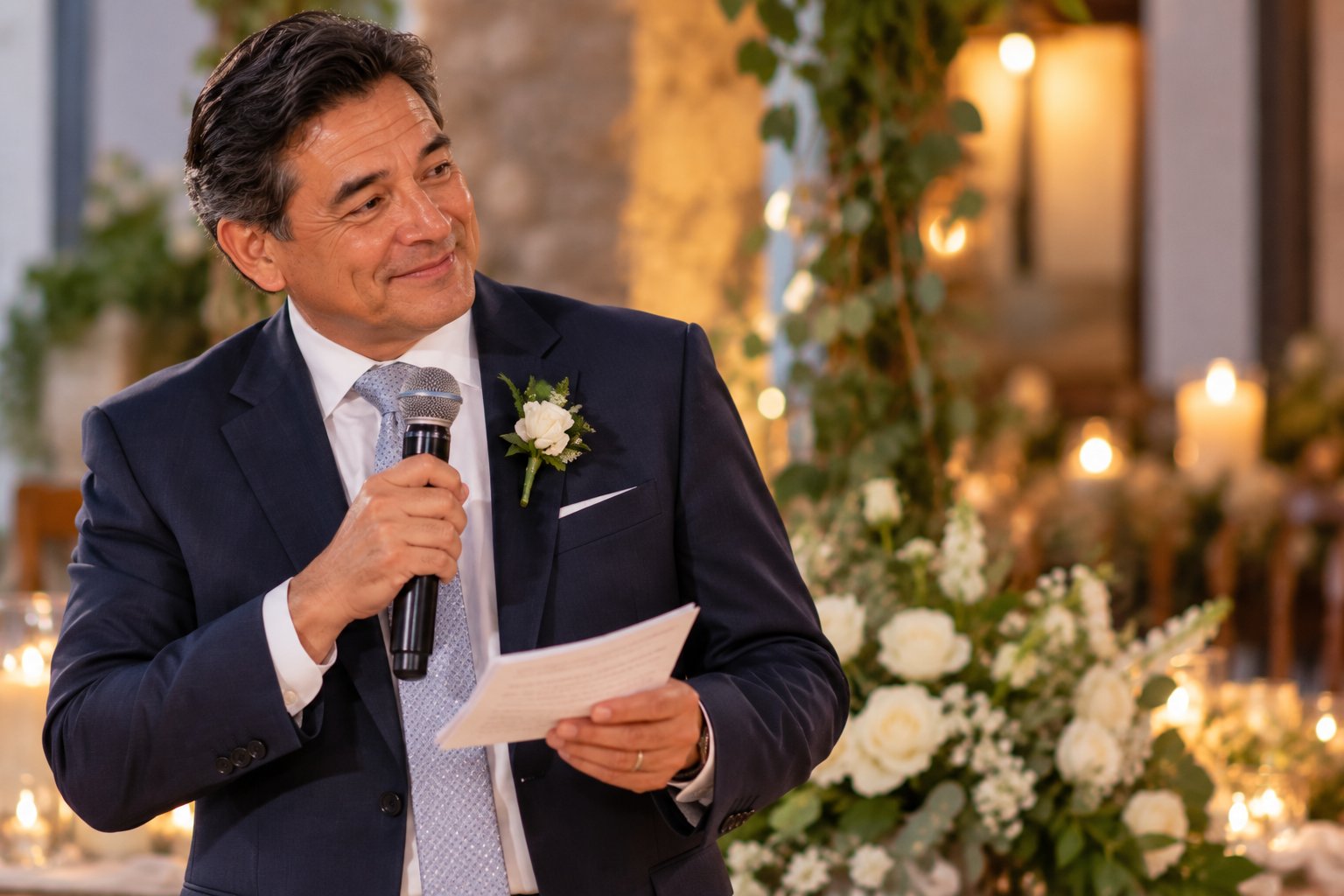
Father of the Bride Speech Examples
These examples are not intended to be memorized word for word.
Use them to discover a tone and structure that feels like you.
Then replace the generic details with your memories, your relationship and your voice.
Example 1: A Warm and Traditional Father of the Bride Speech
Good evening, everyone.
Thank you for being here to celebrate this wonderful day with Emily and Daniel.
As Emily's father, I've had the privilege of watching her grow from a little girl who seemed determined to do everything herself into the remarkable woman sitting here today.
There are hundreds of stories I could tell you. Emily is probably hoping I won't.
But what I remember most isn't one particular accomplishment or event. It's her heart.
Even when she was young, Emily noticed people. She noticed when someone was left out. She noticed when someone needed encouragement. And somehow she usually found a way to help.
When Daniel came into her life, one of the things that struck me was that I saw that same quality in him.
You are kind to each other.
You respect each other.
And most importantly, you seem to bring out something good in one another.
Daniel, we are delighted to welcome you into our family—not simply because Emily loves you, but because over time we have come to love you too.
Emily, being your father has been one of the great privileges of my life.
And to both of you, my hope is that the love we have witnessed today will continue to deepen through all the ordinary days that follow this extraordinary one.
Would everyone please raise a glass.
To Emily and Daniel—to love, laughter, friendship and a lifetime of choosing each other.
Cheers.
Example 2: A Short Father of the Bride Speech
I promise to keep this short, partly because I know there are other people waiting to speak and partly because my daughter has given me very specific instructions.
Sophie, I have been proud of you many times in your life, but today I feel something beyond pride.
I feel grateful.
Grateful for the person you have become, grateful for the relationship we share and grateful that you have found someone who so clearly loves and respects you.
James, we couldn't be happier to welcome you to the family.
The two of you make each other laugh, support each other and, most importantly, allow each other to be yourselves.
So please raise your glasses.
To Sophie and James. May the happiness you feel today be only the beginning.
Example 3: A Father of the Bride Speech With Gentle Humor
When Olivia was about eight years old, she announced that she knew exactly what she wanted her life to look like.
Those of you who know Olivia will be shocked to learn that she had opinions.
Strong opinions.
Detailed opinions.
And occasionally opinions about how the rest of us should be doing things.
So when she introduced us to Michael, I was naturally curious.
Then I watched the two of them together.
Michael doesn't try to change the person Olivia is. He appreciates her strength, makes her laugh and somehow knows when to challenge her and when simply to listen.
Michael, that last skill alone will serve you very well.
But seriously, it has been a joy watching your relationship grow.
Olivia, I have loved watching you become the woman you are today. And Michael, we are genuinely delighted that you are now part of our family.
May you never lose the laughter that brought you together, and may you always be as happy to see one another as you are today.
Please raise a glass to Olivia and Michael.
For more ideas about creating the closing words of your speech, see our Wedding Toasts guide.
A Simple Father of the Bride Toast
If you don't want to give a full speech, you don't have to.
A toast can be simple:
To my daughter and the person she loves. May you always find friendship in each other, laughter in your home and strength in the love you share. To the happy couple.
Or:
May today be remembered not simply as the day you were married, but as the beginning of a long and wonderful life together. To you both.
Or even:
To love, to friendship and to all the ordinary days that will make up an extraordinary life together. Cheers.
If You Are Worried You Will Become Emotional
You may be worried that when you look at your daughter and begin talking about what she means to you, the emotion will become overwhelming.
There is something you can do before the wedding that may help.
Say your speech out loud. Then say it again. And again.
Don't merely read it silently. Speak the words exactly as you will need to speak them at the reception.
At first, a particular story or sentence may bring considerable emotion. That's natural. But when you have spoken those same words many times, they become familiar. The emotional charge often becomes less overwhelming, and you become better able to control your response.
You are not practicing so that you will feel nothing.
You are practicing so that your emotions don't prevent you from saying what you came to say.
Then, when the moment arrives, don't deliver the speech mechanically just because you have practiced it so many times. Slow down. Look at your daughter. Speak thoughtfully, warmly and genuinely. Let the feeling return to the words—but this time you are more prepared for it.
If your voice catches or you need to pause, that's perfectly fine. A little emotion can make a speech deeply moving. Becoming so overwhelmed that you cannot continue, however, can take attention away from the message you wanted your daughter to hear.
Practice the emotion as well as the words.
The goal isn't to give an emotionless speech. It is to be able to say something deeply felt without being overcome by the feelings behind it.
Know Your Speech — Don't Just Read It
You don't need to memorize every word of your father of the bride speech. In fact, trying to remember every sentence exactly as you wrote it can make you more nervous.
But you should know what you want to say.
Practice your speech enough that the thoughts, stories and order become familiar. Ideally, you should be able to stand up and give most—perhaps all—of your speech without looking at your notes.
Keep your notes with you. They are there if you lose your place, forget a name or suddenly discover that your mind has gone completely blank. But think of them as a safety net rather than a script.
The more often you look down to read, the less you are looking at your daughter, her new spouse and the people who have gathered to celebrate with you.
When you talk about your daughter, look at her. When you welcome her spouse, look at them. When you invite everyone to raise a glass, look around the room.
You aren't delivering a paper.
You are talking to people you care about.
Practice until you know what you want to say well enough that the words can come naturally. They don't have to come out exactly as you wrote them. In fact, they may be better if they don't.
Before You Give Your Speech
Read it aloud.
This matters.
Words that look perfectly natural on a page sometimes sound awkward when spoken.
As you practice, ask yourself:
Does this sound like me?
Would I actually say this?
Is there anything here that could embarrass either person?
Have I spent too much time talking about myself?
Have I welcomed my daughter's spouse?
Does the speech eventually become about them, rather than remaining entirely about my daughter?
And have I actually ended with a toast?
If the answer to those questions is yes, you're probably ready.
One Final Thought for the Father of the Bride
You may be tempted to make this speech perfect.
Don't.
Make it yours.
Years from now, your daughter probably won't remember whether every sentence was polished.
She may not remember your opening line.
She probably won't remember whether you spoke for four minutes or six.
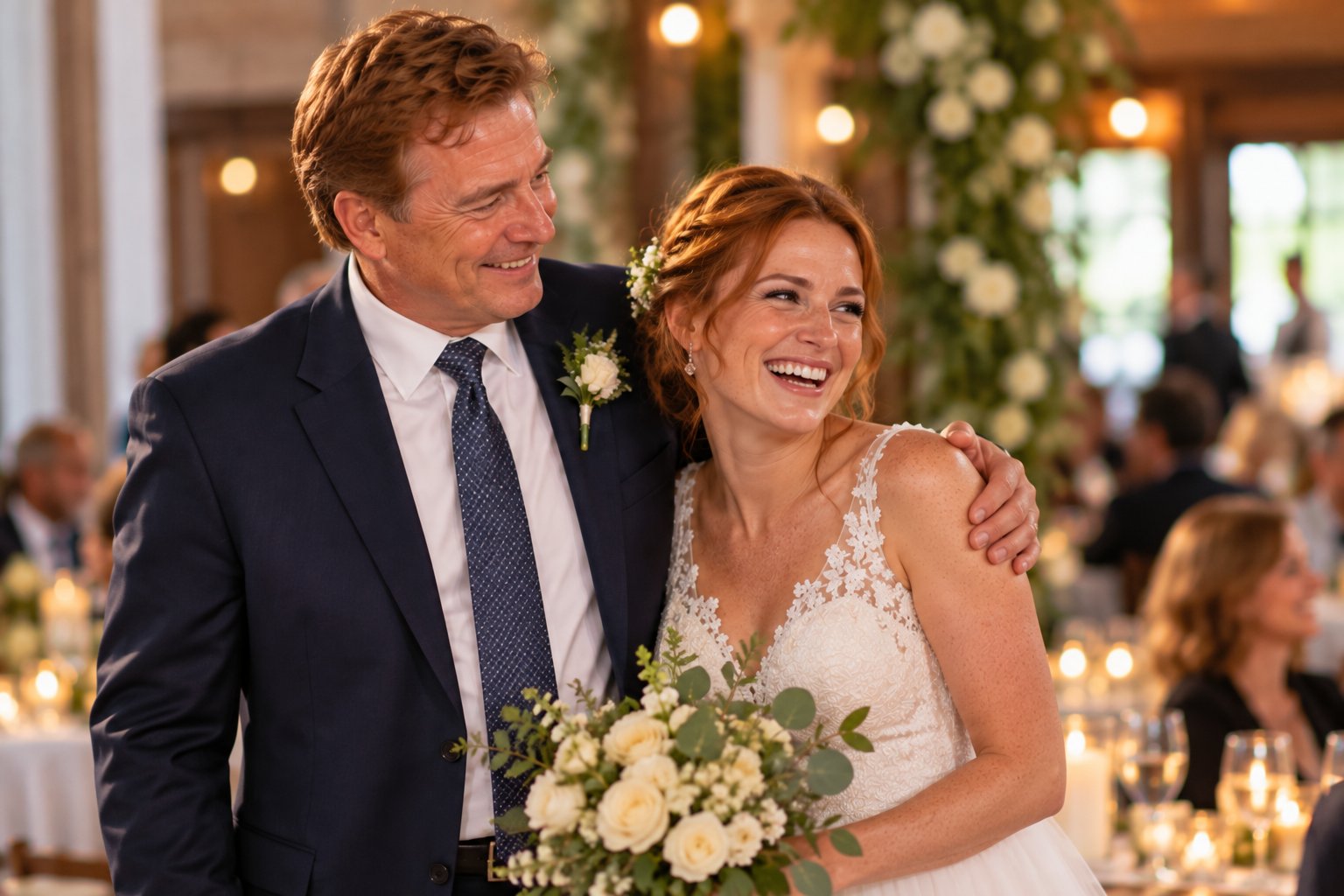
But she may remember looking across the room and hearing her father tell her—in whatever words came naturally—that he loved her, that he was proud of her, and that he was happy for the life she was beginning.
That's enough.
Continue With Your Wedding Toast
For more help with the overall structure, timing and etiquette of wedding speeches, visit our Wedding Toasts guide.
If you're beginning with a blank page, our How to Write a Wedding Toast guide walks you through creating a toast that sounds personal rather than copied.