- Home
- Ceremony Script
Wedding Ceremony Script: Your Complete Guide
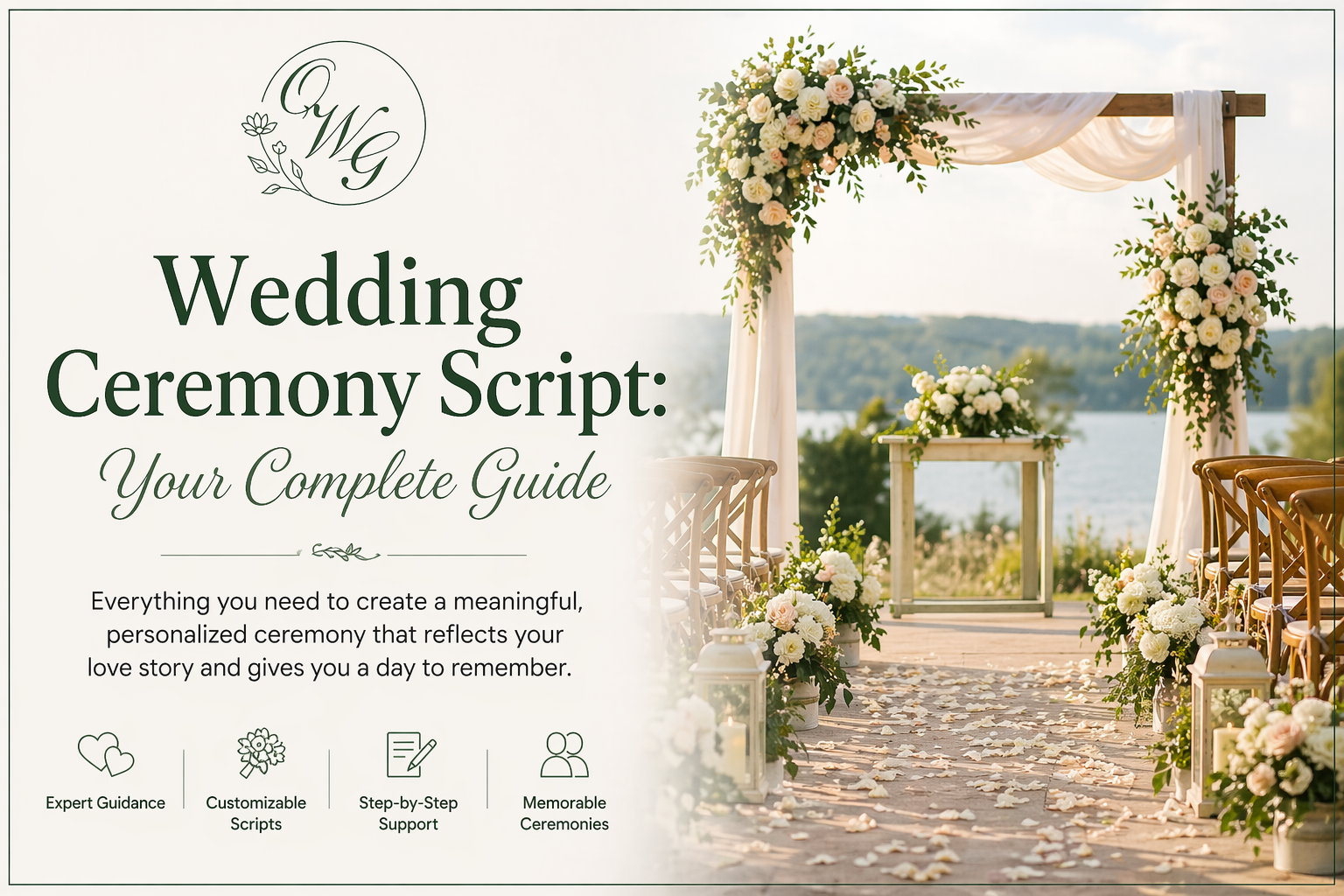
Introduction: Why Your Ceremony Script Matters
Before the music begins, before the celebration unfolds, your wedding ceremony script quietly sets the tone for everything that follows. This complete guide will help you plan, write, and deliver a meaningful wedding ceremony script from start to finish.
Your wedding ceremony script is more than just a sequence of words—it is the heart of your wedding day. It reflects your relationship, your values, your beliefs, and the life you are choosing to build together.
Every phrase spoken during your ceremony has meaning. It is where emotion, intention, and commitment come together in a way that no other part of your wedding can replicate.
When thoughtfully created, your ceremony becomes:
- deeply personal
- emotionally powerful
- memorable for both you and your guests
This guide will walk you through everything you need to confidently create a ceremony script that truly reflects who you are.
What is a Wedding Ceremony Script?
A wedding ceremony script is the complete outline and wording of your ceremony—from the moment your guests are seated to the final recessional. It defines the structure, the spoken words, and how each part of your ceremony flows from beginning to end. Understanding how to structure a wedding ceremony script is the first step in creating a ceremony that feels natural and meaningful.
The ceremony begins with the processional, which sets the tone for everything that follows. Learn how to plan your wedding processional and ceremony entrance order.
A well-crafted wedding ceremony script includes:
- the order of events
- the spoken words for each section
- transitions between key moments
- roles of participants (officiant, readers, musicians, etc.)
Think of your ceremony script as both:
- a blueprint — guiding the structure and flow of the ceremony
- a story — expressing your relationship, values, and commitment
When thoughtfully created, your wedding ceremony script ensures your ceremony:
- flows smoothly
- feels intentional and well-paced
- reflects what matters most to you as a couple
Next, let’s explore the different styles of wedding ceremony scripts so you can decide what feels right for you.
Common Wedding Ceremony Script Styles
There is no single way to structure a wedding ceremony script. The style you choose will shape the tone, wording, and overall experience of your ceremony.
Below are the most common wedding ceremony script styles to help you decide what feels right for you.
1. Traditional Wedding Ceremony Script
A traditional wedding ceremony follows a formal structure that has been used for generations.
- formal tone and sequence
- often includes religious or cultural elements
- time-tested wording and rituals
Best for: couples who value tradition, heritage, and continuity
2. Modern or Contemporary Wedding Ceremony Script
A modern ceremony offers flexibility while still maintaining meaningful structure.
- more relaxed and conversational tone
- customizable wording and flow
- blends tradition with personal elements
Best for: couples who want something meaningful but less formal
3. Spiritual or Religious Wedding Ceremony Script
This style is rooted in faith and spiritual expression.
- includes scripture, prayers, or sacred readings
- guided by religious or spiritual traditions
- emphasizes meaning, purpose, and shared beliefs
Best for: couples who want to express their faith or spiritual values
4. Civil Wedding Ceremony Script
A civil ceremony focuses on the legal aspects of marriage with a simple structure.
- legally focused and officiated by a civil authority
- minimal wording and formalities
- typically shorter in length
Best for: couples seeking simplicity or a non-religious ceremony
5. Personalized or Story-Based Wedding Ceremony Script
A personalized ceremony centers entirely on your relationship and shared journey.
- tells your story as a couple
- includes custom vows, anecdotes, and meaningful moments
- highly flexible and unique
Best for: couples who want a deeply personal and memorable experience
Many couples choose to blend elements from multiple styles to create a ceremony that feels truly their own. Once you’ve identified the style that feels right, the next step is understanding how a wedding ceremony is structured from beginning to end.
The Complete Wedding Ceremony Flow (Step-by-Step)
Regardless of the style you choose, every wedding ceremony follows a natural sequence. Understanding this flow makes it much easier to create a wedding ceremony script that feels smooth, meaningful, and well-organized.
Below is the complete wedding ceremony structure, beginning with the processional, followed by the traditional order you can use as your foundation. Each section represents a key moment in your ceremony, with links to examples, wording ideas, and guidance to help you build your script.
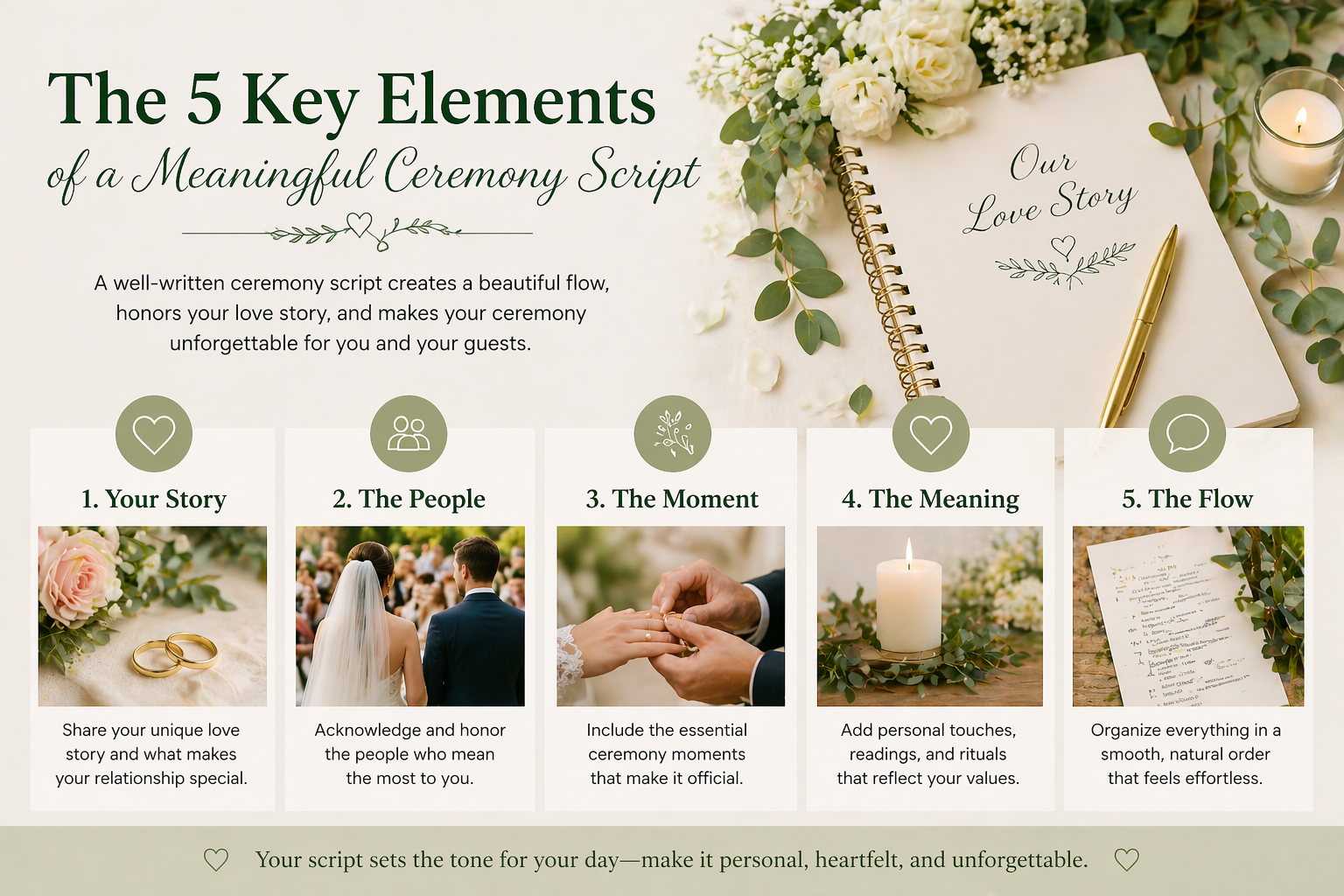
The key elements that shape a meaningful wedding ceremony script
Wedding Ceremony Order (Complete List)
- Wedding Processional
- Presentation of the Bride
- Wedding Welcome Speech
- Including Guests in the Ceremony
- Wedding Readings, Poetry, or Scripture
- Opening Reflection, or Wedding Prayer
- The Charge or Message About Marriage
- Declaration of Intent
- Preface to the Wedding Vows
- Wedding Vows
- Blessing of the Couple
- Preface to the Ring Exchange
- Exchange of Wedding Rings
- Pronouncement of Marriage
- Closing Words or Benediction
- Wedding Recessional
Each section below includes examples, wording ideas, and guidance to help you create your ceremony script that feels meaningful and personal.
Wedding Ceremony Script Examples by Section
As you review each section, consider:
- which elements resonate most with you
- how formal or personal you want your ceremony to feel
- how each part reflects your relationship and values
You don’t need to follow this structure exactly. Many couples adapt or combine elements to create a ceremony that feels uniquely their own.
1. Wedding Processional
The entrance of the wedding party and the couple.
- Sets the tone
- Often accompanied by music
- Can be traditional or fully customized
- Processional and entrance
- Traditional processional order
- Things to consider
- Let there be music
2. Presentation of the Bride
Traditionally:
“Who gives this person…”
Modern options:
- Both families acknowledged
- Self-presentation
- No formal presentation
Who has raised you, provided for you, and loved you, and who has stood with you, and stands with you today
3. Welcome to Wedding Guests: Wedding Welcome Speech
Your officiant greets guests and sets the intention.
Example themes:
- Gratitude for gathering
- Significance of the moment
- Tone (joyful, spiritual, reflective)
- Welcome to this day of celebration
- The love of God is good, and His favor is upon us
- The congregational blessing
- To all who have travelled
- We have come together in this place to share joy
- What brings two people together
- Dear friends, you and I are privileged
- Jordan and Chris have invited us
4. Including Guests in the Ceremony
Ways to involve your guests:
- Group blessing
- Shared reading
- Symbolic participation
- Five ways to include your guests
- Hand muff warmers in winter; fans in summer
- Good wishes basket
- Dear friends and family
These moments deepen connection and meaning.
5. Wedding Readings, Poetry or Scripture
Selections that reflect your values.
Examples include:
- Poetry
- Literature
- Spiritual texts
- Personal writings
- Poetry of Shakespeare, Lord Byron, Rainer Maria Rilke and more
- Spirituality of Gibran and Saint Francis
- Scripture from the Holy Bible
These add emotional depth and perspective.
6. Opening Reflection or Wedding Prayer
A short reflection on love, marriage, or commitment.
This is often where the ceremony becomes:
- Thoughtful
- Meaningful
- Memorable
Our senses are filled with the delights of your creation: its fragrance, color, music, and the touch of friends. Let us taste today the joy and delight of this time that has been set aside for (Bride and Groom).
7. The Charge or Message About Marriage
A short reflection on love, marriage, or commitment.
This is often where the ceremony becomes:
- Thoughtful
- Meaningful
- Memorable
- The dance
- The journey
- The garden
- Wings toward discovery
- Your marriage song
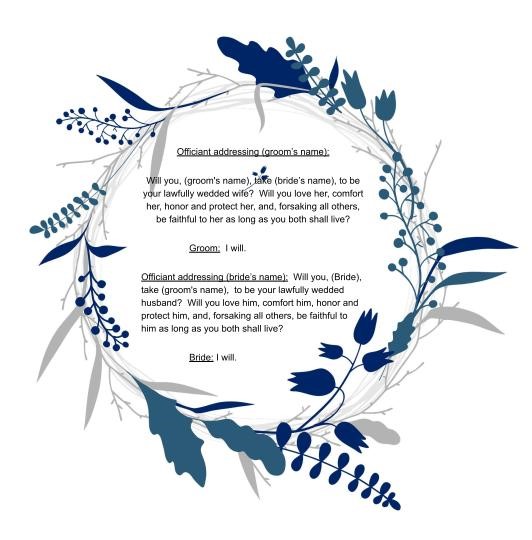
8. Declaration of Intent
This is the formal declaration of intent.
Example:
“Do you take…?”
This confirms your willingness to enter marriage.
9. Preface to the Wedding Vows
A transition into your vows.
This helps:
- Frame the moment
- Prepare emotionally
On their own, they are meaningless, but when rooted in your love, your determination, your passion, and your kindness, they are the strongest force in the world.
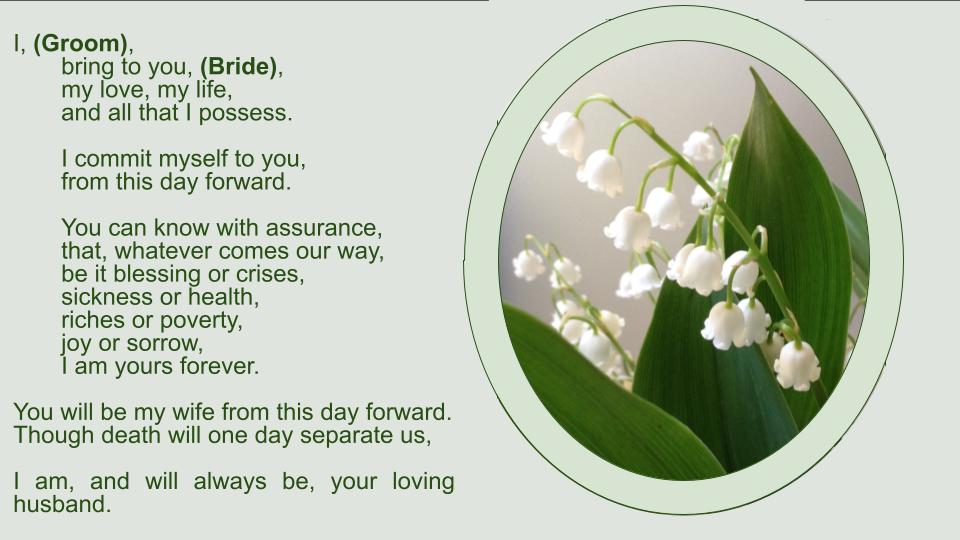
10. Wedding Vows
The most personal part of the ceremony.
Your vows can be:
- Traditional
- Written together
- Written individually
11. Blessing of the Couple
A moment of:
- Affirmation
- Hope for the future
- Shared meaning
Blessings often express:
- Gratitude
- Commitment
- Joy
Blessings convey intimacy and sacredness.
Blessings speak of commendation, appreciation and gratitude in a manner that conveys the highest levels of sincerity.
Blessings speak of that which is of the highest value in life, less about tangible possessions, and more about the elements and value of a virtuous life.
Blessings speak to both the present and the future being joyful for the present, and hopeful for that which is to come.
Blessings express active, rather than passive commitment giving a sense of truth and substance to the occasion.
12. Preface to the Ring Exchange
The tokens that you give to each other were chosen with love and care. As you wear these rings, know that they are the reflections of your partner’s heart. Wear them as a reminder of the love that is yours to receive.
13. Exchange of Wedding Rings
A symbolic act representing:
- Uity
- Commitment
- Continuity
Rings serve as a daily reminder of your promises.
14. Pronouncement of Marriage
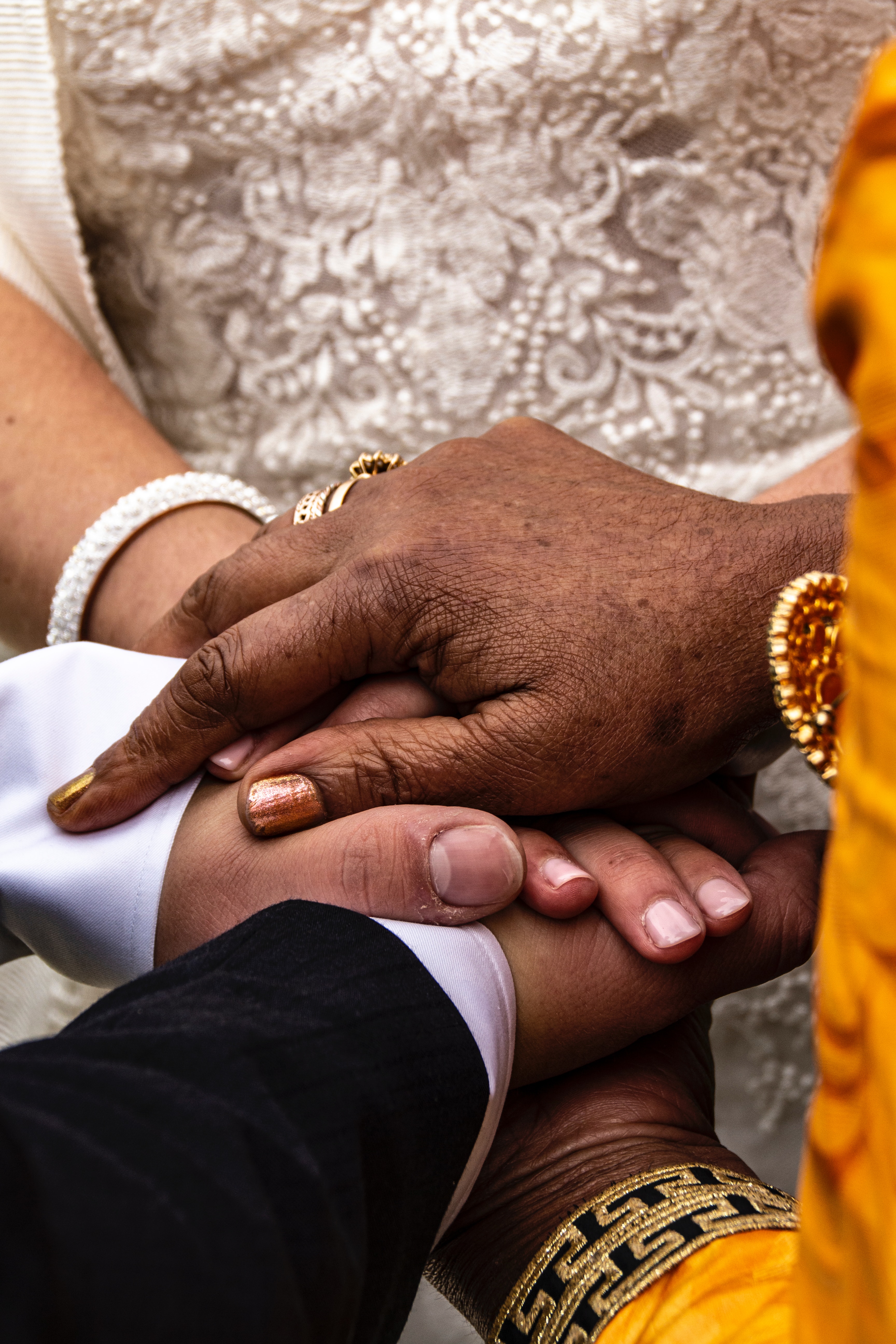
The moment your marriage is officially declared.
This is both:
- Symbolic
- Legal
The pronouncement states that the marriage has taken place.
The two key participants in the ceremony are officially joined together relationally, spiritually, and legally.
They are married!
15. Closing Words or Benediction
Final words of encouragement or blessing.
Sets the tone for what comes next.
May we depart from this place knowing the love of friends, the love of family and the love of God.
Let our beings be filled with anticipation for the time when we will come together again.
Until that time, may the Spirit of God rest upon us, making us mindful of the joy of the Lord.
16. Wedding Recessional
Your exit as a married couple.
This is:
- Celebratory
- Joyful
- Transitional into the reception
- What is a recessional
- What signals that the recessional about to begin
- What is the order of the recessional
- What will be the musical selection for the recessional
- What happens immediately following the recessional
- How will the guests participate in the recessional
How to Create Your Wedding Ceremony Script
Creating your wedding ceremony script is one of the most meaningful parts of your wedding planning. It allows you to reflect your relationship, your values, and what brings purpose to your life together.
As you begin, remember that your ceremony is not just a sequence of events—it is a personal expression of your story.
To create a ceremony that feels authentic and meaningful:
- Take time to reflect on what matters most to you as a couple
- Choose wording that aligns with your beliefs, tone, and vision
- Consider how each part of the ceremony contributes to the overall experience
You may find it helpful to:
- Keep a journal of ideas, phrases, or readings that resonate with you
- Revisit your notes over time as your vision becomes clearer
It is also important to work closely with your wedding officiant. Many officiants have preferred wording or structure for certain parts of the ceremony.
Be sure to:
- Review your script together
- Confirm alignment on tone, wording, and expectations
- Clarify any legal or traditional requirements in advance
Taking time to thoughtfully plan your wedding ceremony script will help ensure your ceremony feels personal, intentional, and true to who you are.
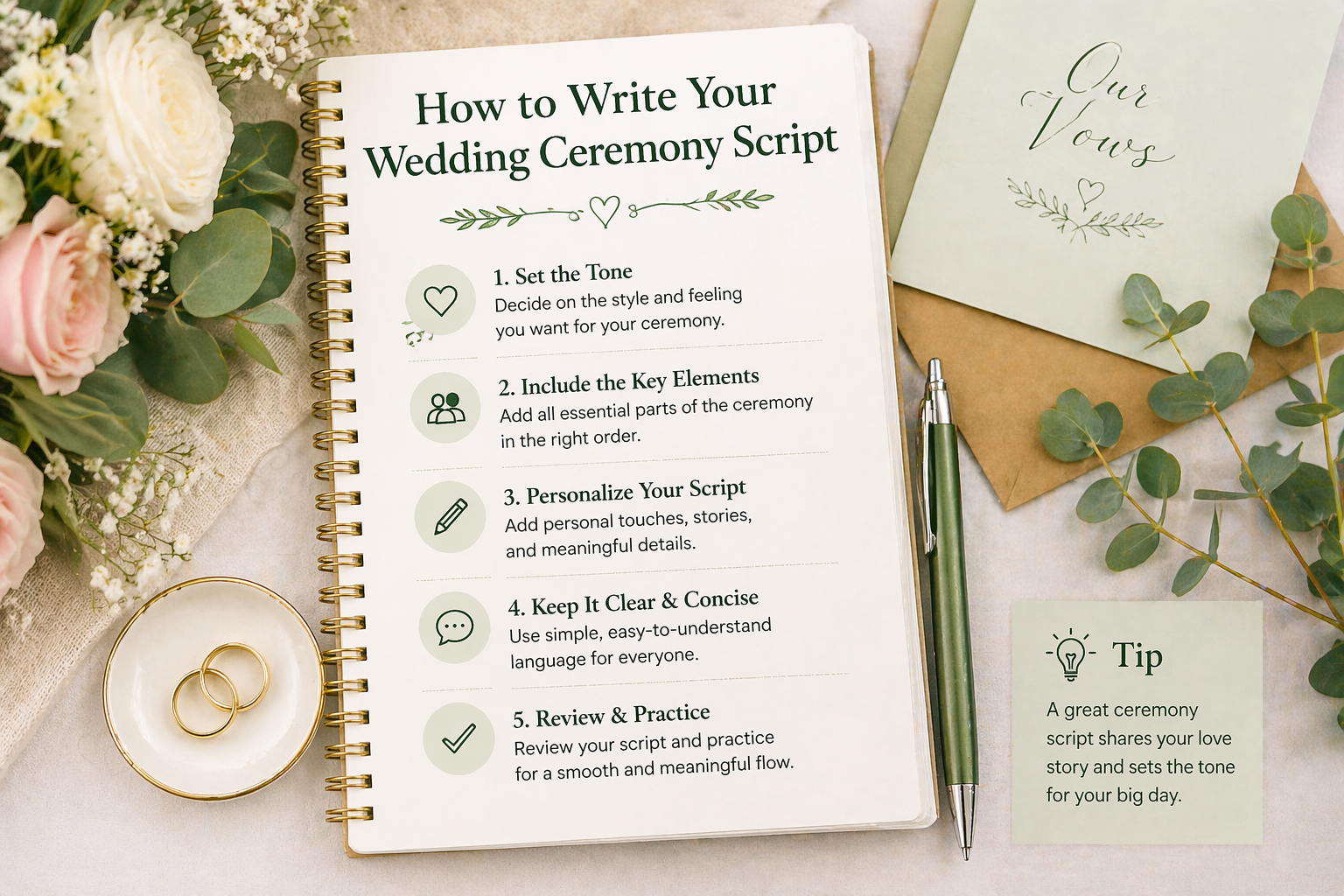
Step-by-step guide to writing a meaningful wedding ceremony script
Step 1: Define Your Vision
Ask yourselves:
- Do we want formal or relaxed?
- Spiritual or secular?
- Traditional or modern?
Step 2: Choose Your Structure
Use the ceremony flow above as your foundation.
Step 3: Select Meaningful Content
As your original page suggests:
Choose words that resonate with you
Consider:
- What reflects your relationship
- What feels authentic
- What you want remembered
Step 4: Write or Customize Each Section
You don’t need to write everything from scratch.
- Adapt existing wording
- Personalize key moments
- Focus on authenticity
Step 5: Collaborate with Your Officiant
This is critical.
As noted in your original content:
- Alignment with your officiant ensures your vision is respected
Discuss:
- Wording preferences
- Legal requirements
- Timing and flow
Step 6: Review and Refine
Take time to:
- Read your script aloud
- Adjust tone and pacing
- Ensure it feels natural
How to Use This Ceremony Structure
Now that you’ve seen the full wedding ceremony flow and examples for each section, the next step is to begin shaping a ceremony that reflects your relationship, your values, and the experience you want to create.
You don’t need to follow every element exactly as outlined. Instead, think of this structure as a flexible framework—a guide you can adapt, simplify, or personalize based on what feels meaningful to you.
As you review each section of the ceremony, take time to consider how it fits into your overall vision.
You may choose to:
- Keep traditional elements that feel important
- Modify wording to better reflect your personality
- Remove sections that don’t resonate
- Add personal touches such as stories, readings, or symbolic moments
The goal is not to create a “perfect” ceremony—it’s to create one that feels authentic and intentional.

Before You Finalize Your Ceremony
As you explore the options and examples provided, ask yourselves:
- Do any of these suggestions truly resonate with us?
- Will our wedding officiant support the selections we are considering?
- In what areas are we willing to compromise?
- What do we want our guests to feel and remember most?
Taking time to reflect on these questions will help you move from simply choosing elements… to designing a ceremony that genuinely represents who you are as a couple.
Once your ceremony structure is in place, the next step is ensuring everything flows smoothly on the day itself.
Tips for a Smooth Ceremony (Navigation & Coordination)
A beautiful ceremony script needs thoughtful and confident execution.
Keep it flowing
- Avoid long pauses that interrupt the moment
- Ensure transitions between sections are clear and natural
- Maintain a comfortable rhythm from beginning to end
Coordinate with participants
Take time to connect with everyone involved in your ceremony:
- Readers
- Musicians
- Officiant
Clear communication helps ensure that everyone understands their role and timing.
Rehearse
Even a simple walkthrough can make a meaningful difference.
This allows you to:
- Refine timing
- Confirm positioning
- Build confidence
Prepare for flexibility
Something may not go exactly as planned—and that’s okay.
The goal is not perfection, but a ceremony that feels genuine, meaningful, and true to you.
Frequently Asked Questions
How long should a ceremony be?
Typically: 20–30 minutes
But it depends on:
- number of readings
- cultural elements
- personal preferences
Do we have to write our own vows?
No.
Options include:
- traditional vows
- shared vows
- fully custom vows
Can we change the order?
Yes.
The structure is flexible as long as:
- legal elements are included
- the flow still makes sense
What if we feel overwhelmed?
Start simple.
You can:
- use templates
- adapt existing wording
- build gradually
How early should we finalize the script?
At least 2–4 weeks before the wedding
This allows:
- rehearsal
- officiant review
- final adjustments
Final Thoughts: Creating a Ceremony That Reflects You
Your wedding ceremony is not about following a script perfectly—it’s about creating a moment that feels true to who you are.
Every choice you make—from the structure and wording to the vows and readings—shapes an experience that reflects your relationship, your values, and the life you are beginning together.
There is no single “right way” to design a ceremony. What matters most is that it feels meaningful, intentional, and authentic to you.
Take time to reflect on what matters most. Choose the elements that resonate. Let go of anything that doesn’t.
Work together, stay aligned with your officiant, and trust the process as your vision becomes clearer.
When your ceremony reflects your story, it becomes more than just a part of your wedding day—it becomes a memory you will carry with you for the rest of your lives.
Take what resonates, adapt what matters, and create a ceremony that truly reflects your story.